
- guid.rest
Gallery
Take a closer look
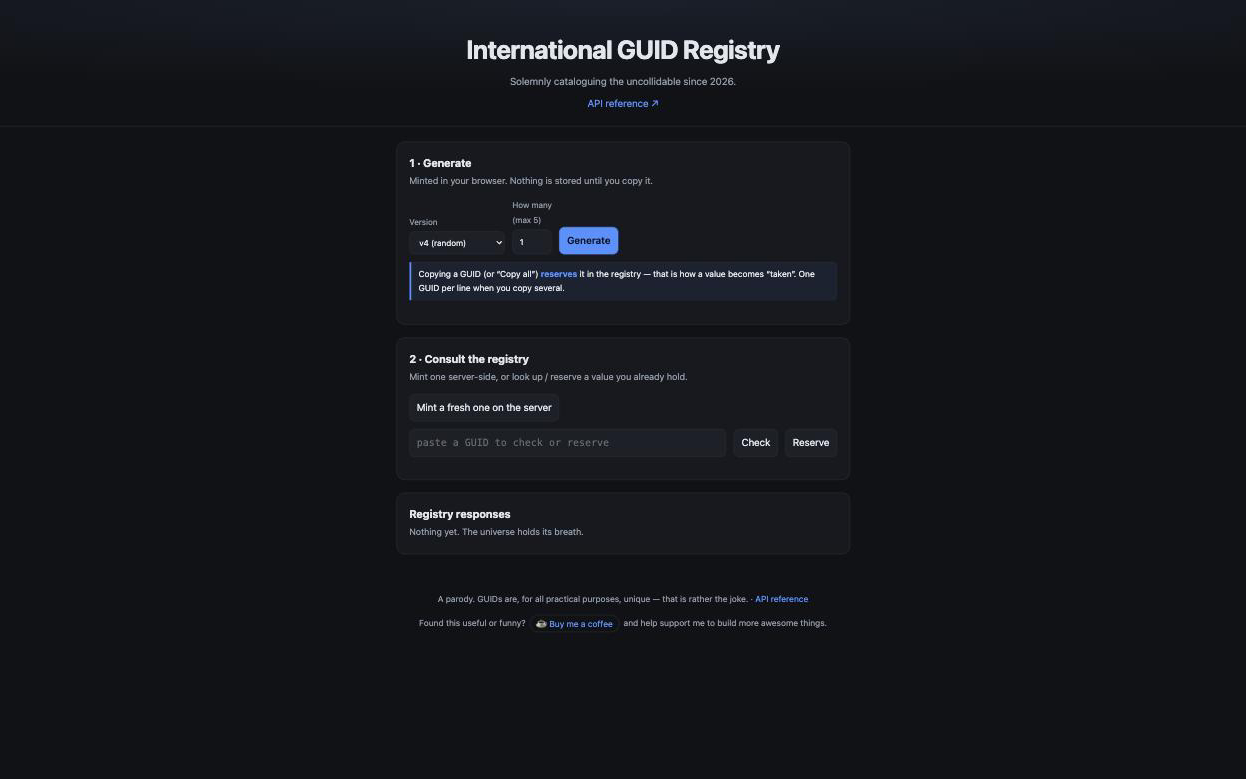
1 screen from International GUID Registry, shown in a browser frame.
- guid.rest
Features
What International GUID Registry does
Mint and reserve GUIDs
Generate up to five GUIDs in the browser. Nothing is stored until you copy one, at which point it is solemnly reserved in the registry.
Consult the registry
Check whether any GUID has already been used, mint a fresh one server-side, or reserve a value you already hold via a clean REST API.
The collision is the joke
Uniqueness is enforced by a DynamoDB conditional write: registering a value already on record fails the condition and becomes the 409. That is rather the point.
Proper API manners
RFC 9457 problem+json errors, source-generated JSON with no reflection on the hot path, and an OpenAPI document enriched with concepts and examples.
Self-hosted interactive docs
A Scalar API reference at guid.rest/docs with a downloadable Postman collection wired into the sidebar by a custom plugin.
Serverless on the free tier
Cloudflare Pages fronts a .NET 10 Lambda (arm64, SnapStart) behind a Function URL. No API Gateway, no CloudFront, no S3, and effectively no hosting bill.
Built with
The world's most earnest registry of impossible duplicates
The International GUID Registry is a parody with a straight face. GUIDs are, for all practical purposes, unique (that is rather the joke). Yet guid.rest will dutifully check yours against the record, mint fresh ones on request, and register the collision when it inevitably isn't one. Copying a generated GUID is what reserves it: a small ceremony that turns a random number into a matter of public record.
A serious API wearing a silly hat
Under the humour sits a properly engineered service. The API is a .NET 10 Minimal API with source-generated JSON and typed results (no reflection on the hot path). It returns RFC 9457 problem+json for every failure, including the load-bearing 409 Conflict. Uniqueness is a single DynamoDB conditional write, so the registry's central gag is also its data-integrity guarantee. An interactive Scalar reference lives at /docs, complete with a runnable Postman collection.
Serverless to the last penny
The whole thing runs on a deliberately frugal architecture. Cloudflare's free plan provides DNS, TLS, DDoS protection and per-IP rate limiting, while Cloudflare Pages serves the dependency-free static front end. A Pages Function proxies /api/* to a .NET 10 Lambda on arm64 with SnapStart, protected by an edge-injected origin secret. There is no API Gateway, no CloudFront and no S3. Infrastructure is AWS CDK in C#, deployed by GitHub Actions with a live smoke test on every merge.
Have a product in mind?
From a first sketch to the App Store, we design and ship software that feels effortless. Tell us what you are making.